WITCH HEAD NEBULA
This is my first attempt at the Witch Head Nebula, I hope you can see the profile image of the Witch in this close-up shot.
The Witch Head Nebula was always just out of reach for me. From my old home under Bortle 8–9 light polluted city skies, I knew it was there, but totally invisible to my camera sensor. As a reflection nebula composed of interstellar dust, illuminated only by the intense light of Rigel, a blue giant star, no amount of optimism could overcome the city's skyglow. I was saving this target for when I would go out camping with the family in the winter. For a couple of years, that did not happen, though.
Moving to Texas and having dark skies now has changed that in a very personal way. Now under Bortle 4-5 skies, I'm able to capture its faint phantasmagorical form from my own backyard, the Witch Head slowly emerges, subtle. Capturing it feels like a technical achievement and a milestone for me. This image is not just about better skies; it’s about patience, never stopping to learn, so I could capture a piece of the universe that was always there, waiting.
I’m sharing 2 stretches of it from the same data, my fisrt one was really soft and I though I could push the data further to reveal more dust and I was right, ther was more data to be revealed by going a bit more aggressive in the stretch, First one was VeraLux Hyper Stretch and the second one I used Seti Astro Statistical Stretch 3.x
8h 08 min total integration time | 97x300s
Sharpstar 61 EDPH II + 0.8 reducer 274mm @f4.5
ASI183MC PRO dedicated astrocamera
AM5 Mount
SVBONY UV/IR cut filter
SVBONY 30mm f4 Guide Scope
ASI120MM mini guide camera with red filter
ASIAir mini
Bortle 4-5
Software: DeepSkyStacker > Siril > Veralux Alchemy > Starnet > VeraLux HMS > Graxpert > Cosmic Clarity > Photoshop > Topaz Denoiser
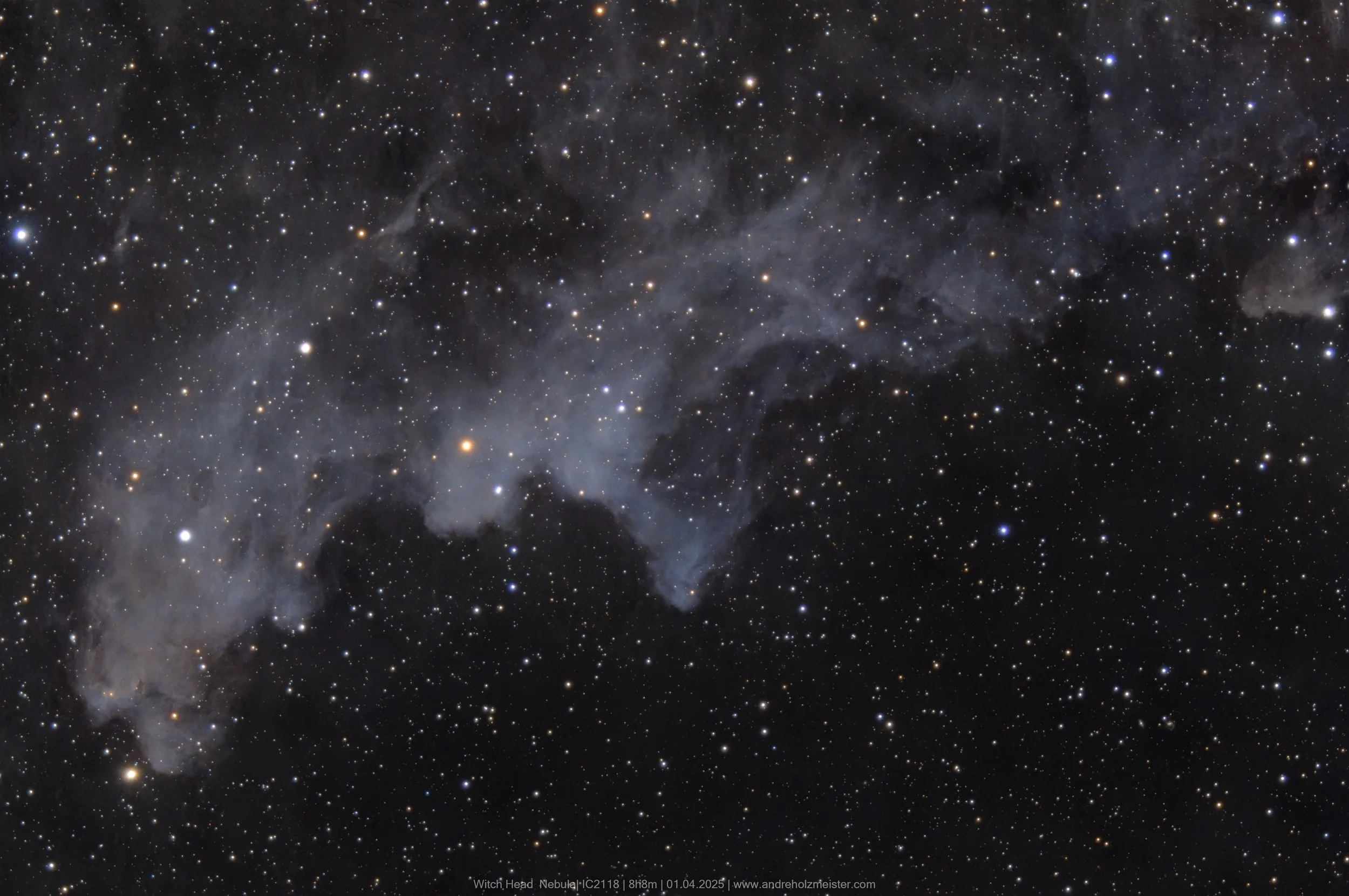
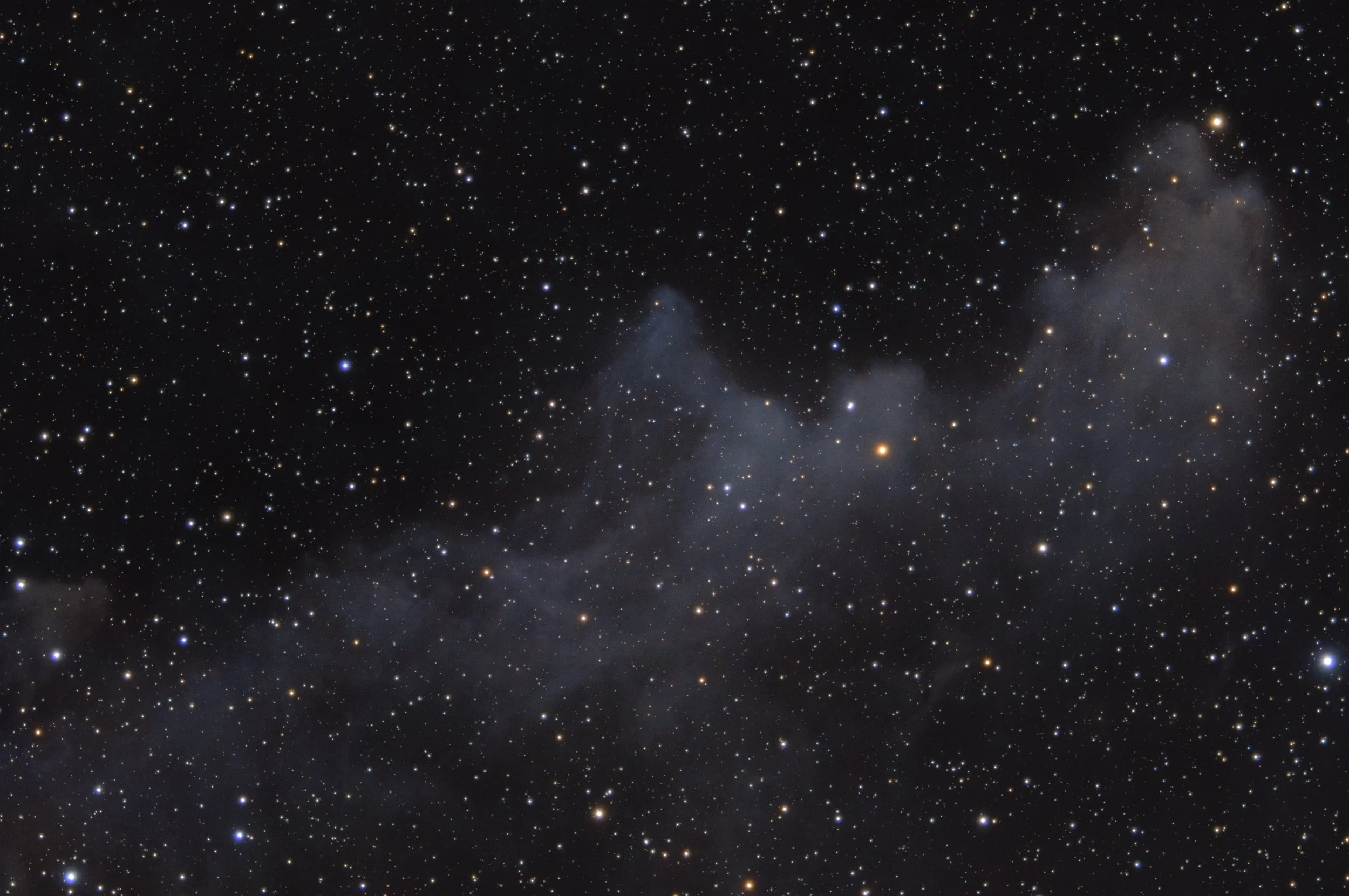
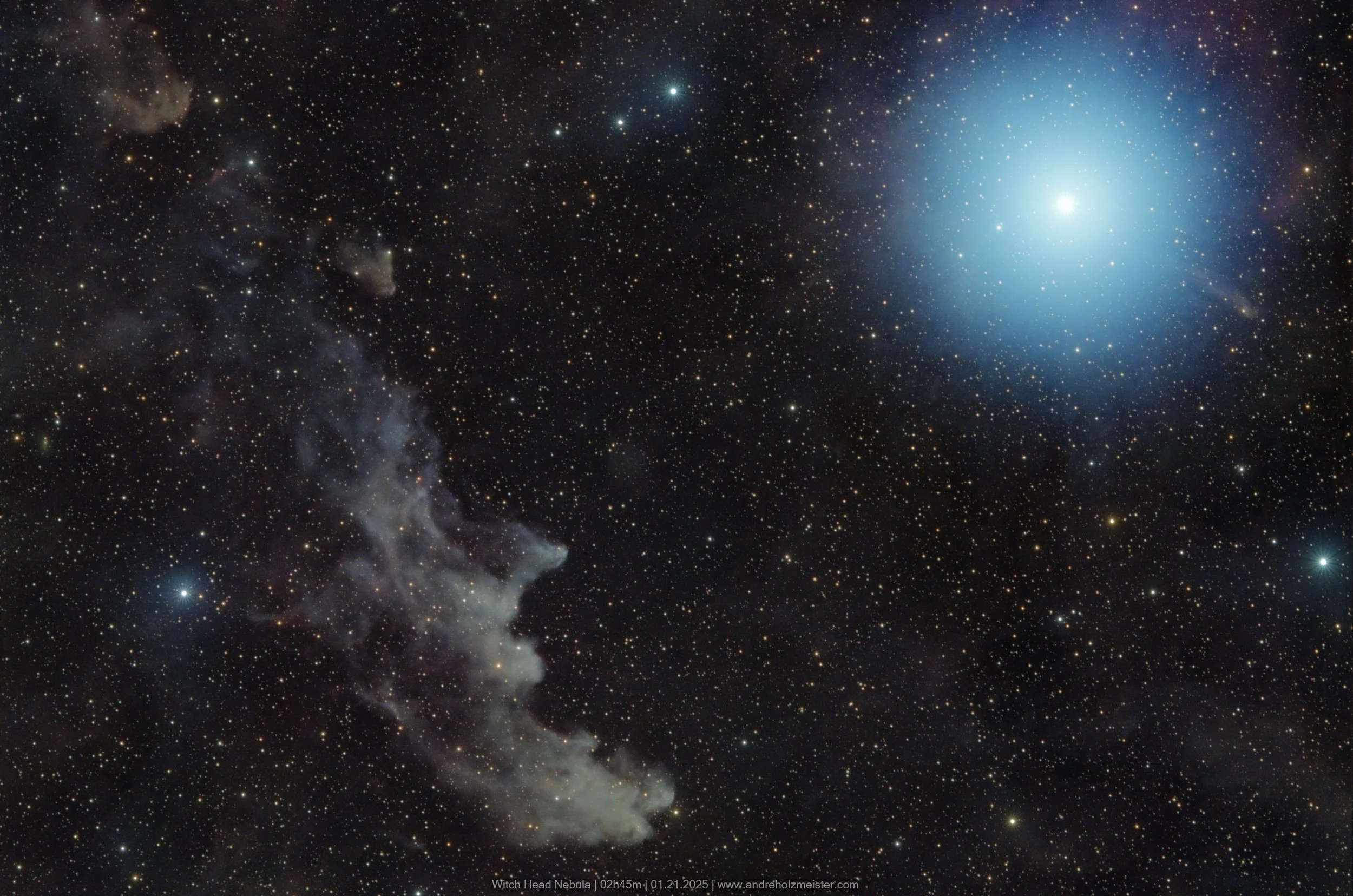
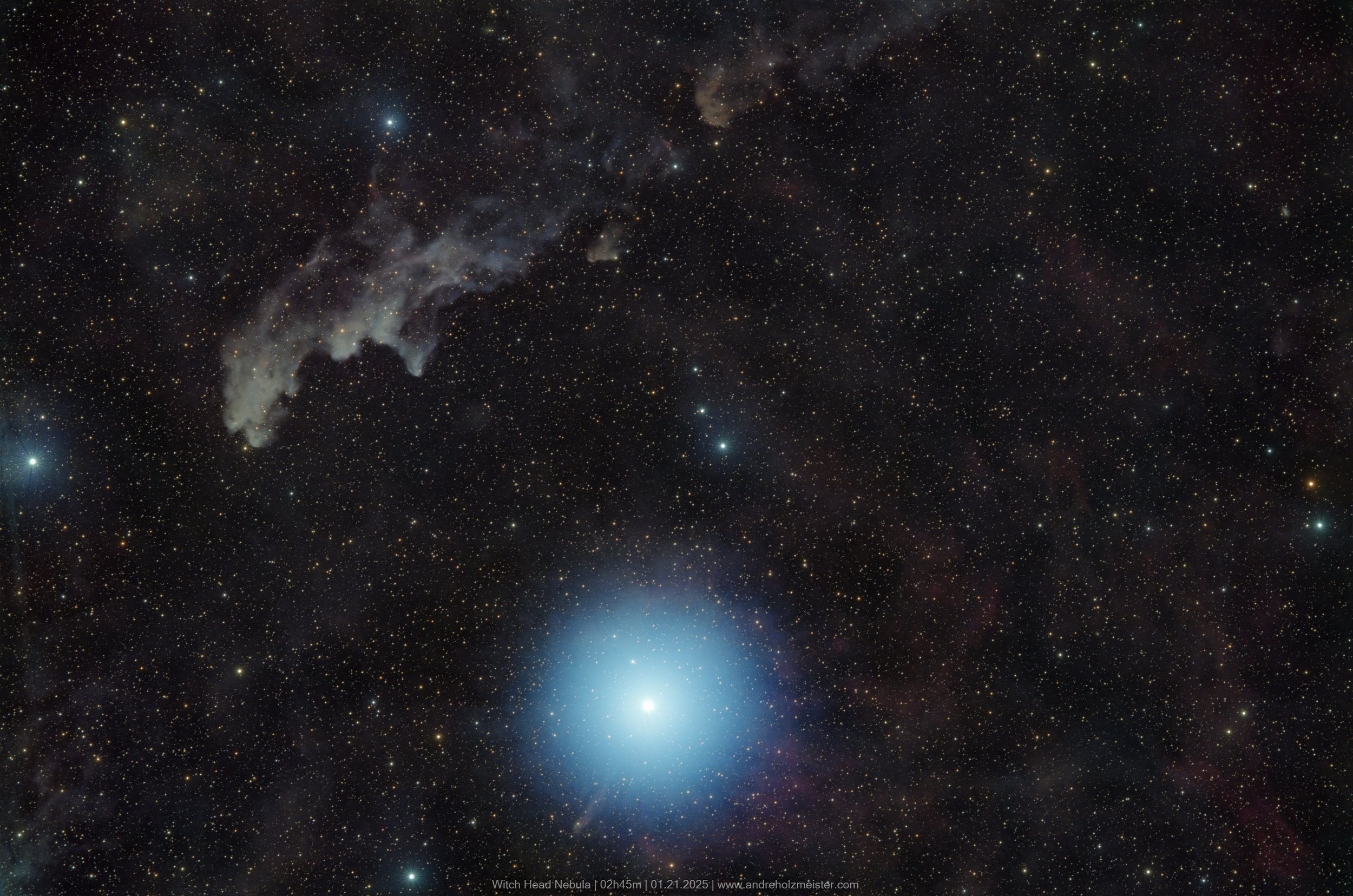
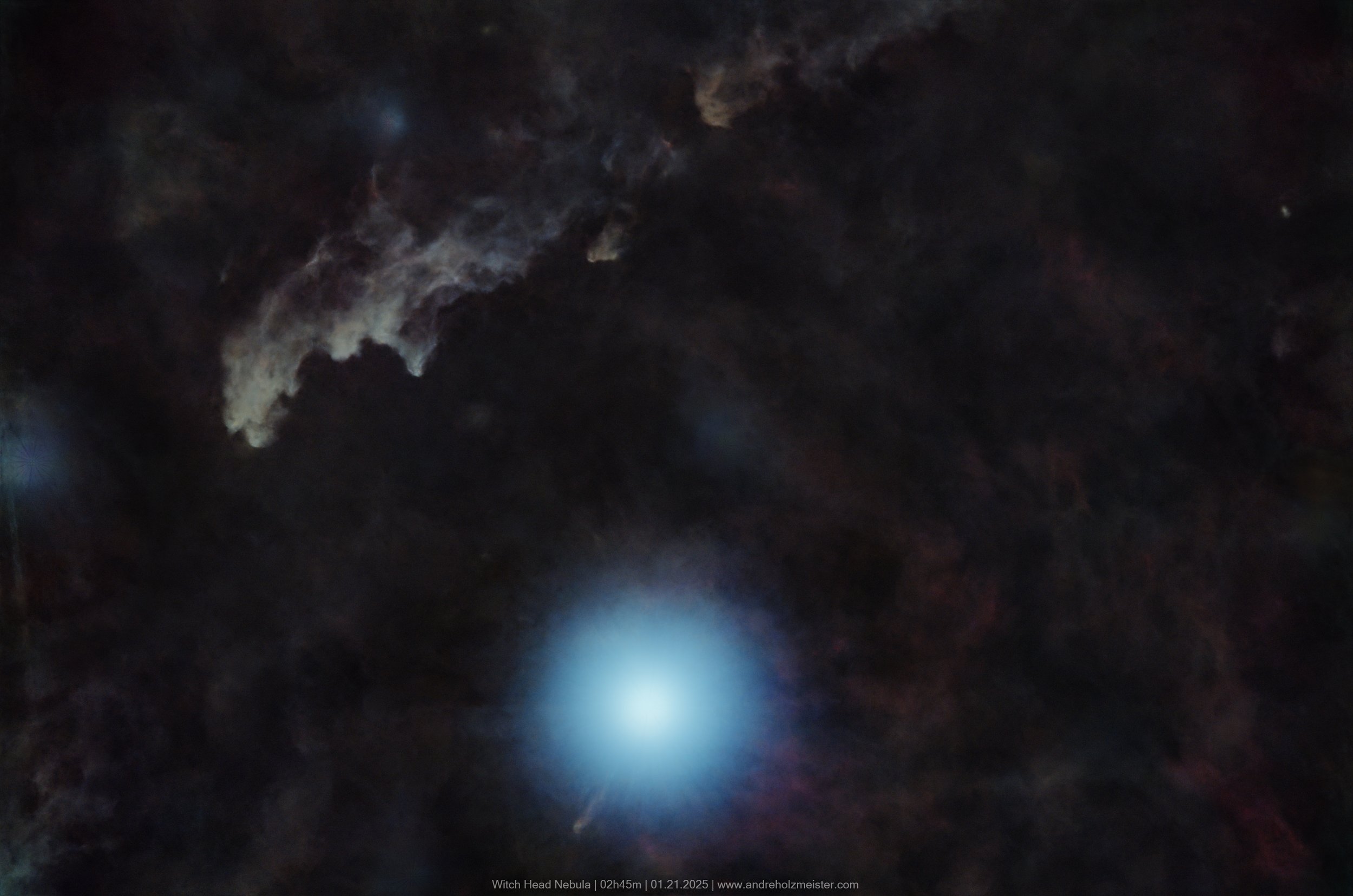
The Witch stares at her magic orb, or a hypnotic spell?
Rigel doesn’t just sit near the Witch Head Nebula in the sky — it activates it. The Witch Head (IC 2118) is a reflection nebula, meaning it doesn’t glow from its own ionized gas the way Orion does. Instead, its dust grains scatter and reflect the light of nearby stars, and in this case the dominant spotlight is Rigel, the brilliant blue-white supergiant in Orion. Rigel’s intense light hits the thin dust cloud and gets preferentially scattered toward us at shorter (bluer) wavelengths, which is why the Witch Head takes on that cold, ghostly blue tone.
Scientifically, this duo is a kind of lesson in visibility. Without Rigel, IC 2118 would be far harder to detect at all — the dust would still be there, but it would blend into the darkness, a structure without a signature. In that sense, Rigel acts like a cosmic lamp, revealing the shape of the interstellar medium. Rigel is a blazing, short-lived giant nearing the end of its stellar life, while the Witch Head is made of cold dust — the raw material that can eventually become new stars and planets. Light from a star nearing its finale reveals the faint structure of future beginnings.
This is 2h 45 m of integration from Bortle 4-5. I’ll update this when I get more data on it.
Rokinon 135mm f/2 @f/2
ASI294MC PRO dedicated astrocamera
AM5 Mount
SVBONY UV/IR cut filter
SVBONY 30mm f4 Guide Scope
ASI120MM mini guide camera with red filter
ASIAir mini
Bortle 4-5
Software: Siril > Starnet > Graxpert BG and Denoise > VeraLux HMS, Revela > CosmicClarity Sharpening > Photoshop